

What Is "Cardiometabolic Health"?
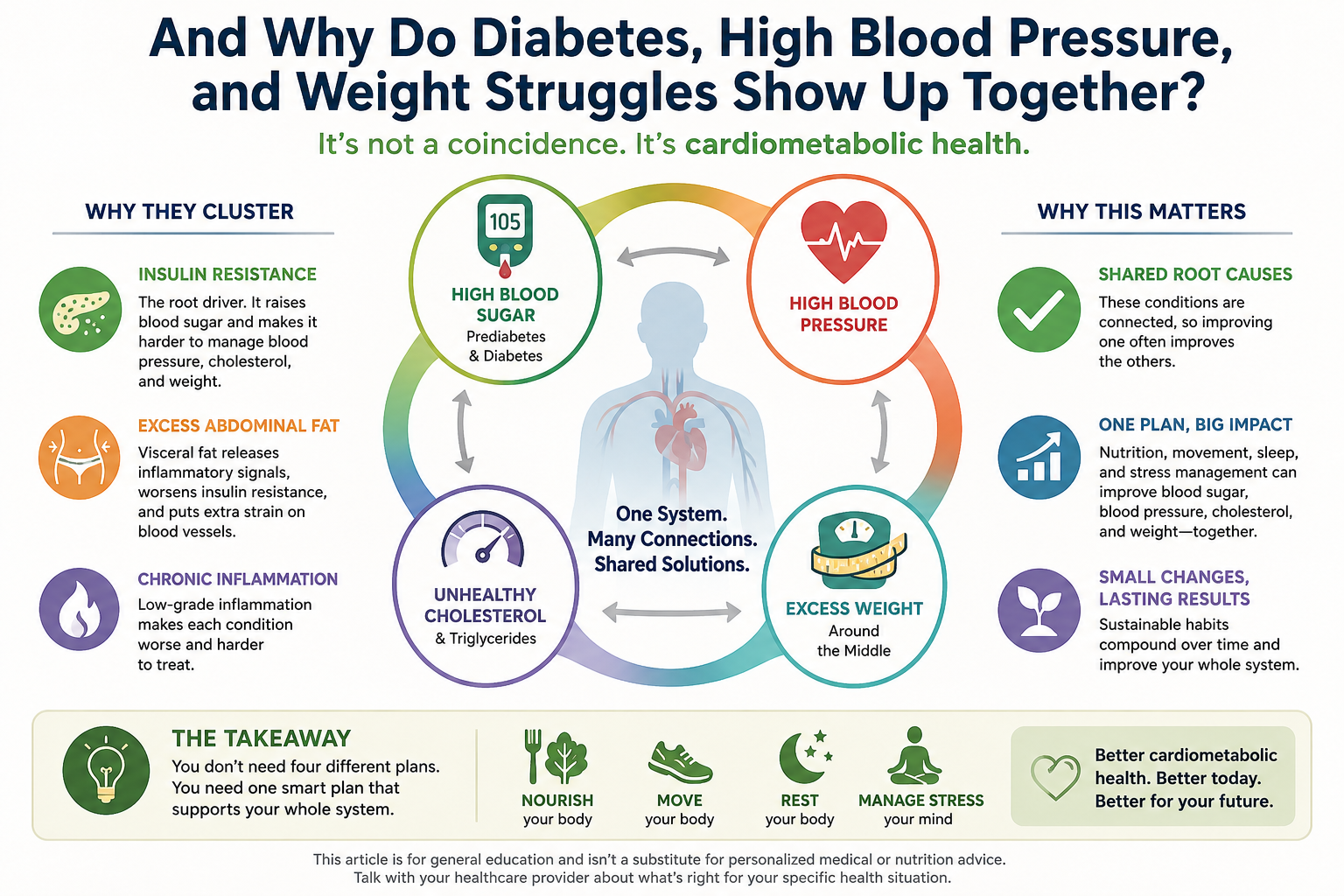
And Why Do Diabetes, High Blood Pressure, and Weight Struggles Show Up Together?
If you've been told you have prediabetes and high blood pressure, or you're working on your weight while also watching your cholesterol, you've probably noticed something: these conditions rarely travel alone. There's actually a name for that pattern: cardiometabolic health. Understanding it can change the way you think about managing your own.
Breaking Down the Term
"Cardiometabolic" is a mashup of two systems that are more connected than most people realize:
Cardio refers to your heart and blood vessels, your cardiovascular system.
Metabolic refers to how your body regulates energy, blood sugar, and fat.
Cardiometabolic health describes how well these two systems are working together. When one starts to struggle, the other usually feels it too. That's why a single visit to your doctor might touch on your blood pressure, your blood sugar, your cholesterol, and your weight all in the same conversation. They're not separate boxes to check. They're pieces of the same picture.
Why These Conditions Cluster Together
It's not a coincidence that type 2 diabetes, high blood pressure, high cholesterol, and excess weight around the middle so often appear as a package deal. Researchers point to a few shared root causes:
Insulin resistance is the common thread. Insulin is the hormone that helps move sugar out of your bloodstream and into your cells for energy. When cells stop responding to insulin the way they should, your body compensates by producing more of it. Over time, that resistance doesn't just raise blood sugar. It also encourages your blood vessels to stiffen, nudges cholesterol and triglyceride levels in the wrong direction, and makes it easier to gain weight (especially around the abdomen), which in turn worsens the insulin resistance. It's a feedback loop, not four separate problems.
Excess weight, particularly around the abdomen, feeds the cycle. Fat stored around your organs (called visceral fat) behaves differently than fat stored elsewhere. It releases inflammatory signals that make insulin resistance worse and puts extra strain on your blood vessels, which contributes to rising blood pressure.
Chronic, low-grade inflammation ties it all together. Excess weight, insulin resistance, and high blood pressure all promote a low-level inflammatory state in the body. That inflammation, in turn, makes each of the individual conditions harder to manage, which is part of why treating them in isolation often falls short.
The medical term for this specific cluster, when someone has a combination of excess abdominal weight, high blood pressure, elevated blood sugar, and unhealthy cholesterol or triglyceride levels, is metabolic syndrome. You don't need every single marker to be "off" for your cardiometabolic health to matter; even one or two can be an early signal worth paying attention to.
Why This Matters (Beyond the Diagnosis)
It's easy to hear all of this and feel like your body is working against you on multiple fronts at once. We'd rather you walk away with the opposite takeaway: because these conditions share root causes, the things you do to improve one tend to improve the others too.
This is genuinely good news. It means:
You don't need four completely different action plans for four different diagnoses.
Improving your nutrition, movement, sleep, and stress management can move the needle on blood sugar, blood pressure, and weight simultaneously, because you're addressing the shared mechanisms underneath them.
Small, sustainable changes compound. You're not just managing symptoms one at a time; you're improving the whole system.
What You Can Do With This
Understanding that these conditions are connected is the first step. The next step is figuring out which changes matter most for your specific situation: your labs, your lifestyle, your preferences, and what's realistic for your life right now.
This article is for general education and isn't a substitute for personalized medical or nutrition advice. Talk with your healthcare provider about what's right for your specific health situation.
